Research
Bicycle-based air pollution measurements
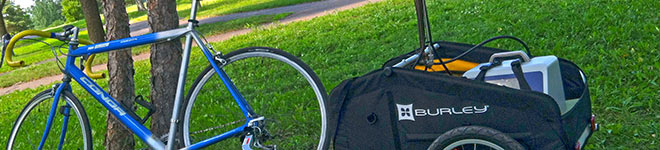
I measured air pollution using a modified bicycle trailer to carry equipment that measures various aspects of particulate air pollution (i.e., particle number concentration, black carbon, PM2.5, and particle size distribution). The measurments will be used to (1) estimate typical concentrations in various urban environments, (2) develop a land-use regression model for particulate air pollution, and (3) compare spatial patterns of air pollution and non-motorized traffic.
A news clip describing the project can be seen here and a newspaper article here.
I recorded video for a subset of the sampling runs. The video clip below shows short clips of footage for segments of the sampling routes in low and high air pollution environments. I first ranked all black carbon measurements by percentile and binned by quintle; then I pulled clips that had a minimum of 30 consecutive seconds in one quintile. The video shows compiled clips in each quintile (increasing from low to high black carbon concentrations).
Measuring and modeling non-motorized traffic
Measurements and models of bicycle and pedestrian traffic are needed to better plan for active travel. Since 2010 we have measured mixed-mode off-street trail traffic at six locations in Minneapolis, MN (partner organizations: Minneapolis Parks and Recreation Board; City of Minneapolis Department of Public Works). Our research focuses on (1) estimating statistical models of non-motorized traffic and (2) developing scaling relationships for short-duration traffic counts to estimates of annual traffic.
The research project page is here, a video here, and journal article here.
Designing healthy, clean neighborhoods
A widely studied aspect of designing healthy cities focuses on increasing physical activity. A less studied area is how to mitigate exposure to hazards during active travel (e.g., air pollution). A key question is how development patterns impact air pollution and health as well as greenhouse gas emissions.
A journal article describing a risk assessment of air pollution and physical inactivity for different neighborhoods in Los Angeles is here. Journal articles that estimate the built environment's impacts on motor vehicle greenhouse gas emissions are here and here.
Cookstove interventions in rural Uganda
Indoor air pollution is a major risk factor globally. One strategy to mitigate this risk (in rural areas where switching from solid fuels is difficult) is to introduce more efficient wood-burning stoves. As part of an Engineers Without Borders (EWB) project we introduced a locally manufactured "rocket" stove to 50 households in rural Uganda. We measured both air pollution concentrations and stove temperatures (proxy for usage) before and after the introduction of the new stove to quantify differences in indoor air pollution.
The EWB-UMN Uganda project webpage is here.